
One Word, One Community

PHYSEDagogy just delivered their keynotes at the National PE & Sport Institute in Asheville, North Carolina. The main idea of the One Word, One Community afternoon keynote was to share what continues to push us as individuals and as group in physical education. The seven of us chose one word that represents our thoughts, captures our feelings, and provides us strength as we look forward to the upcoming school year. At the conclusion of our Keynote, we invited the audience to share their one word. We were so inspired by what the audience shared, we wanted to learn more about why people chose their word. Now you have a chance to share it with us.
If you would like to share your word with the physical education community, please fill out the form below by pressing on the button. This will take you a blog template (Google Form) that you can use to share your word and an explanation of why your word continues to push you in your physical education life. Once you complete the form, it will be posted on our website for all to see. Thanks!
If you didn’t get a chance to see our keynote, then feel free to watch by clicking on the link below:
One Word, One Community Keynote

Get Connected with EduMatch

Sarah Thomas is a Regional Technology Coordinator in Prince George County, MD. Sarah currently holds a master’s degree from Howard University in the field of Curriculum and Instruction and is a doctoral candidate at George Mason University. Sarah is the founder of EduMatch, a passion project that helps educators connect globally. Sarah started EduMatch in 2014 and since then has become a global phenomenon using social media to help connect educators all over the world.
Checkout the podcast: Get Connected with EduMatch Podcast

“I love to connect with other educators, because I strongly believe that we are all experts at something, and can learn so much from each other! Let your voice be heard, and let’s all grow together.” Sarah Thomas
I was fortunate enough to catch up with Sarah to talk about some of her upcoming projects.
Jorge: Sarah, thank you for agreeing to do this interview. I would like to start with talking about EduMatch. Can you explain a little about EduMatch and how you came up with the idea?
Sarah: EduMatch is a global network of educators who learn together using social media. We build strong relationships in order to be able to talk about the issues that really affect our students. One Friday night in September 2014, I was chatting with my friend Rafranz Davis on Voxer. We started talking about gamification in math, and I told her of a recent conversation I had with my cousin on the same topic, and how I wished she, him, and another mutual friend, Chris Aviles, could get together and talk. This made me wonder if something existed to connect educators around similar interests. Yes, there were Twitter chats, but I couldn’t find anything that specifically introduced educators to one another. So, I created an account, a Google Form, and a really ugly logo, and tweeted out to see if anyone would be game to try. An educator in Australia said he would, and after he filled out the form, I tweeted this information out using relevant hashtags. At the end of the day, he reported that he made several new connections. This was our very first “Person of the Day.” Rafranz then encouraged me to make a website, and as people signed up, they brought their amazing ideas. This is how EduMatch has grown over the years.
Jorge: One of the things I really admire about you is that you are a self-described introvert, yet you keynote and present at conferences around the world. How do you work through your shyness and how would you encourage others to do the same?
Sarah: Thanks, Jorge! I read an article once that said to reduce nerves, take the focus off of yourself and place it entirely on the message. In addition, I channel my alter-ego, Sarahdateechur, to deliver the message for me. This usually works. I know that things went well if I don’t remember what I said, haha.
Jorge: One of the many great things that has come out of your passion to connect educators is EdCamp Voice, which is coming up on July 7th and 8th. How did the idea to do an ed camp on Voxer originate, and how can people learn more about the event?
Sarah: Back in 2015, a few of us were chatting about how it would be cool to do an edcamp on Voxer. We decided to try it and see what would happen, and had the first round in December 2015. It went so well that we decided to bring it back, then again, and now again for our fourth round. This format was great because if you’re anything like me, you suffer from FOMO (Fear of Missing Out), and this allows you to be in all of the rooms! In addition, as someone who is pretty shy, I am usually super-conscious to not interrupt people in face-to-face sessions, which usually leads to me not saying anything at all. However, that problem is eliminated in Edcamp Voice, where you’re not bound by time. As a matter of fact, one room, AR/VR in Edu, has been going strong since the first round. We encourage people to continue the conversation for as long as they like after the closing, and add their rooms to the EduVox List. People can learn more about Edcamp Voice by going to our website, edcampvoice.com.
Jorge: EdCamp EduMatch is happening August 5th. Can you tell us about that and how people can learn more about the event?
Sarah: Absolutely! We are about to launch our third Edcamp Edumatch, where Edumatchers from around the world will come together to learn online from 10 am – 12 pm ET. We plan to use the MIT Unhangout platform, which is really cool. We have been using it for the past three years, and it looks like they made some cool changes to the interface, which we are excited to see. People can find out more by going to edcampedumatch.org.
Jorge: These events take a lot of time and work to put together. Why do you do it?
Sarah: I love learning with educators around the world, and feed off the energy and ideas that my colleagues bring. Yes, it’s a bit addictive…but I feel like I learn so much being a fly on the wall in these spaces.
Jorge: What is your vision for the future of EduMatch?
Sarah: The beauty of EduMatch is that it belongs to the community. Everyone who joins brings a piece of him/herself and that’s how it grows. A lot of the crazy things we do, like starting a Voxer group or a podcast, for example, comes from someone saying, “hey guys, why don’t we try X?” I have a couple of ideas for the future, but it’s pretty open-ended. I’m confident we will be publishing more books together…we are talking about maybe doing a conference one day, and releasing a mixtape in the near future. I’m looking forward to what will hopefully be a lifetime of learning together.
I would like to say thank you to Sarah Thomas for her passionate work and dedication to our profession. I encourage everyone to checkout EduMatch.org and follow Sarah on Twitter, @sarahdateechur, to learn more about what’s going on in the EduMatch community.
Breakout EDU: 5 Components of Fitness Superhero Training
Today, in my physical education class, I attempted my first Breakout EDU and it was awesome! Breakout EDU is an immersive learning experience where students have to work together to solve puzzles to open a locked box. You can learn more by checking out the Breakout EDU website here. I first learned about Breakout EDU from a conversation I had with Justin Schleider on Voxer. I remember him telling me that Breakout EDU was something many educators around the country were trying out and I was very intrigued. The idea comes from the escape room game concept, which locks willing participants in a room and gives them a game scenario. Then, they have to work together to escape the room within a predetermined period of time. Here is a fun video of Conan O’Brien participating in an escape room.
When designing my Breakout EDU experience, I wanted to include a relatively well-known concept in PE, so I chose the 5 health–related fitness components. We had just finished up our FitnessGram assessment and I thought it would be a nice time to reinforce some of the concepts my students just learned. Then, I decided on a superhero theme to go along with the components of fitness and also incorporated physical activities that were associated with each clue. Here is the link to the complete PDF: Superhero Training Breakout PE
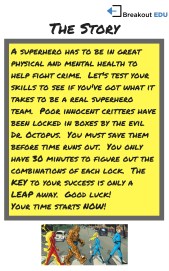 To plan my students’ experience, I started off with a story. My students love playing with critters so I thought I’d get them involved in the scenario. Dr. Octopus seemed like a suitable villain and cute little critters seemed to be the perfect characters to save. I wanted to include time for some set-up, reflection and clean up at the end, so a 30-minute task seemed about right. I developed clues to figure out the combination of each lock and considered how my students could use their physical and mental skills to help them solve the puzzles. I set up each box and now it was time to test it out.
The next step was to heterogeneously divide the teams and assign them their proper starting location and area. I have four Breakout EDU kits and my classes average about 24 students, so we had about 6 students to a group. I assigned a record keeper, tablet handler, mediator, and an encourager for each team. I told them that the experience might be a little frustrating, but I would be making my rounds to make sure everyone was on the right track. I told them the point of the game is to figure it out and that learning is not always linear. I asked them to be creative with their thinking and honor outside-of-the-box ideas. I asked them to try, fail and repeat until they found success. I read the scenario and started the timer.
Inevitably, some groups insisted on no help, while others pleaded for clues. I told each group that a consensus would have to be reached before a clue, of which they had two, could be used. The truth, however, was that I was constantly walking around giving unofficial clues. I wanted them to be challenged, but also successful. So, I watched and listened as each group read their first clue.
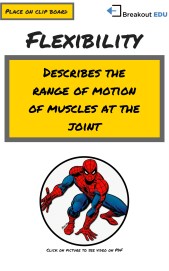 Each definition associated with each clue came from videos published by the Cooper Institute. A playlist of the videos can be found here. Each definition also has an activity that goes along with it.
After the activity, my students had a chance to reflect on the experience using some reflection cards that are included in the Breakout EDU kit. They had conversations about what worked, what they could improve upon, and how their group worked together to solve each problem. Here is a video of my kids in action: https://youtu.be/hzIvvOvOX5A
As we w ere lining up for our transition back inside, several of my students went out of their way to tell me how much they enjoyed the activity. Fortunately for us physical educators, Mark Foellmer has created this site with other breakout ideas for PE: www.cbhpe.org/breakout-edu. Also, be sure to checkout the latest episode of the Global PhysEd Voxcast on PhysEd Breakout EDU.
The process was frustrating, messy, and full of setbacks. That being said, my students and I loved it. This, in many ways, is what learning should be.


 PHYSEDAGOGY