
Introducing #PhysEdSummit Basecamps

The #PhysEdSummit team is proud to present our newest monthly professional development project called Basecamps!
Click Here to Submit a Proposal
The PHYSEDagogy team is in the beginning stages of planning the #PhysEdSummit 3.0 and the first ever #PHYSedcamp at the National PE Institute, and trust us….they will both be BIG! Take a look above at the timeline to know when to expect different #PhysEdSummit professional development opportunities to take place.
As we were planning for these next professional development opportunities, we realized that there will be a pretty long gap in our professional development offerings (except the PHYSEDagogy Podcast which will continue to be offered monthly).
The team came up with the idea of “Basecamps.” These will be our monthly “Webinars” that will lead up until the next “Summit.” They will be 45-60 minutes in length and will be ran and moderated just like our sessions in the #PhysEdSummit (through Google Hangouts and an interactive tool like Today’s Meet). Everything about these opportunities will be “organic.” The ideas for the Basecamps will be generated from physical educators across the globe. Anyone can submit a proposal to be a facilitator (a.k.a. Sherpa) and lead a Basecamp. If you are interested in facilitating a presentation please click on the link below to submit a proposal.
Click Here to Submit a Proposal
Voices of #PhysEd: APE Through the Student’s Eyes
After teaching Adapted Physical Education now for 9 years, I spend a lot of time planning my lessons by first looking at what content am I going to deliver and then how am I going to deliver the content to my students with disabilities. We all know that students with disabilities have the right to access the same curriculum as the general education classes, but it is up to the highly trained Adapted Physical Education teacher to decide the adaptations or modifications that need to be made for the students to be successful. It often helps if I first look at the content I am going to deliver through the eyes of my students.
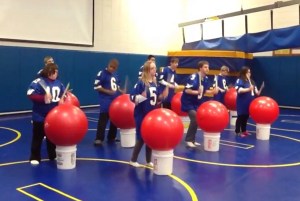 I often think about students that are physically impaired, but are not necessarily cognitively impaired that are in the general education PE setting. I know that all they want in life is to not look different in their general education classes.
“Do I really have to have this extra teacher here in the gym with me? Having this person following me around the entire time is really embarrassing. I just don’t want to look different.”
I think about what it must be like for a high school student that just wants to fit in with their peers to have the “extra” teacher in the room hovering around. Years ago I met an Adapted PE teacher from Kansas named Margery Thompson. She had a slide on her powerpoint that was titled “The Dance”. First I thought we were going to discuss one of the greatest Garth Brooks songs from my senior year in high school, but I was wrong. What she talked about next changed the way I work with my Adapted PE students that are placed in the general education setting. Margery said that you need to do “The Dance” with the students.
If they need assistance in a skill STEP IN, but then STEP OUT. If they need extra clarification on the rules of the activity STEP IN, but then STEP OUT. If they need reminders on proper behavior STEP IN, but then STEP OUT.
Over time I have come to realize that some of my students need me to dance slow like the prom, but some of my students need me to dance fast like a 4 AM rave party. It’s a delicate balance of giving the student just enough support to be successful, but not too much support where they look different by having the extra teacher with them.
What about my students that are not able to have their voice heard? What about my students that do not have the ability to communicate at all? All students have a desire to be active, but when you can’t communicate your needs to your teacher a lot of frustration can set in. Sometimes it is just simpler to give up on learning a skill when my teacher doesn’t know what I need to be successful. I often need to take the time to hear my students voice through their facial expressions and body language. Everyone has the ability to communicate their needs. The way those needs are communicated can be very different depending on the student. I look for those visual cues that tell me the students are getting frustrated with the progressions of the skill being taught and I know maybe it’s time for me to change my approach. It is so very important that these students of mine feel success with the skill development. Making the right modifications to the activity, equipment, and/or time of a skill will allow the student to feel success and be excited to continue participating in the activity.
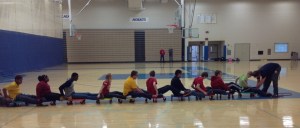 I often think about my students with cognitive impairments that are in a separate Adapted PE class and what it is like when they come to the gym. My students use their iPads to scan a QR code in their Special Education Reading and Math room before they come to Adapted PE The QR code takes them to a Google Doc with words AND pictures that shows them the order of the activities that we are going to do today including the location (gym, weight room, wrestling room, outside). I try to lessen any anxiety they might have when coming to the gym area.
The voices I hear from these students tell me that they need the learning progressions taught in a simple way. They need more complex skills broken down into smaller parts that are slowly demonstrated visually and sometimes require hand over hand assistance. When it comes to small sided games they need the rules to be pretty basic and they need to be given the opportunity learn by doing. 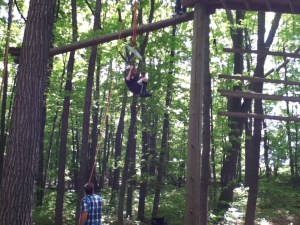 I feel my students frustration when basic movement patterns and motor skills that their grade level peers have acquired many years ago are still so difficult for them to process. My students need the reassurance that their frustrations will soon turn to joy when that first birdie is served legally over the net, that first base hit from a pitched ball in a game of whiffle ball, or even that first time independently climbing the 35 feet to the top of the ropes course. When my students with disabilities are given the opportunity to build confidence and acquire the knowledge and skills needed to someday independently participate in recreational and fitness activities their voices tell me that are incredibly thankful for the chance to be physically educated in a specially designed setting that allows them to learn at pace that caters to their individual needs.
Please remember that students with disabilities often have a very difficult time having their Voices of #Physed heard. All students deserve the opportunity to be physically educated and have that education delivered to them in a way that is appropriately based on their individual needs.
The voices of Adapted Physical Education are sometimes overlooked when designing a Quality Physical Education program, but we all must remember that “All Quality Physical Education is Adapted!”
Voices of #PhysEd: The Growth Mindset and Invisible Disabilities

Teaching students to have a growth mindset has become a trend within education over the past few years. The idea of the growth mindset is based upon research on achievement and success by Stanford University Psychologist Carol Dweck. The growth mindset says your ability to learn isn’t fixed, but rather the harder you try the more likely you are to learn a specific concept or skill. In my physical education program I have worked hard to teach my students to have a growth mindset and embrace life struggles as opposed to trying to overcome them. My strong desire to instill in my students the idea that failure is okay and that great learning results from failure comes from my own life experiences, specifically, being diagnosed with a learning disability. I would like to shine some light on what it’s like to be a student with a learning disability and ways in which physical education teachers can meet the needs of students like myself.
My Story
When I was five years old, I was identified as having a learning disability. Unlike physical or mental disabilities, my learning disability is not readily noticable. It’s unique and invisible to others. My learning disability affects multiple subject areas, including math, reading, writing and spelling (I’m using my voice to dictate this blog rather than type it). These are all things that take me at least twice as long to work through as the average person.
Starting at a very young age I had many people in my life who were invested in my success academically. These people included my parents, my teachers and professors, and other specialists who worked at the schools I attended. Through their willingness to investment in me I was able to be successful throughout my career as a student and beyond.
One of the reasons I had so much support over the years was that I learned how to advocate for myself. My biggest obstacle in learning to advocate for myself and ask for help was being able to understand that I didn’t need to overcome my disability but rather embrace it as a strength. What I mean by this is everything that I have been able to accomplish in my life has been derived from the determination and persistence I developed because of my learning disability. Seeing my learning disability as a strength took a lot of time, maturity and encouragement by others for me to realize. However, by the time I started college I had come to view my learning disability in a positive light. I became an expert at advocating for myself by sitting in the front row of my college courses, getting to know my professors really well and allowing them to see how hard I was working. This led to me being able to have a few D+’s changed to C-‘s so that I could get into graduate school and pursue my Master’s in Physical Education Teacher Education. Although it seemed that everyone else was studying less than me and receiving higher grades, I was able to celebrate my growth and progress through small successes, such as receiving a passing grade on my physics final.
As I reflect on how I struggled and clawed my way through school I can see how it has really shaped me as a physical educator. I believe every teacher has had different life experiences that contribute to their strengths as a teacher, and I believe my learning disability has given me the ability to help students who not only have visible disabilities but also to take notice of and advocate for ones who have hidden or invisible disabilities. Listed below are several ways I have discovered to help develop a growth mindset in students who perhaps struggle in one way or another in physical education. 
Relationships
We are all very aware that relationships are a key component to students finding success in a physical education setting and helping to remove barriers that could inhibit learning. I think this is even more true when working with students with learning disabilities.
As physical educators we have the skill of quickly scanning and assessing our students’ ability to perform a task, and we can see if they were or were not able to perform well on a cognitive test. When we have a student who is not performing well, the question to ask ourselves is why is this happening. By having a great relationship with our students we may be able to answer this question more quickly and correctly. A relationship is an investment and takes work, but it always pays dividends. Simply spending a few minutes having an independent conversation with a student and learning how to relate to them can build a high level of trust. Trust is key when it comes to fully engaging in learning. With trust comes a feeling of safety, and when a student feels safe they are more comfortable with failure and making mistakes.
Individualized Education Program (IEP)
If your physical education setting is anything like mine then you teach a large number of students. This school year I teach a total of 650 students. It is difficult to get to know this many students personally and is why I suggest that you request to be included in all the IEP’s in your school. It is important that if some of your students have a different way of processing learning, you know about it and can make the proper learning accommodations. Being involved in an IEP for those students is a way to get on the right track and is often an untapped resource for physical educators.
Give Students a Taste of Success
Having a learning a disability takes grit! By grit, I mean a commitment to learning long term, through the ups and downs. Grit is the key to success when students process things slower, and in order to develop grit students must first feel success. I suggest finding small ways to show students with learning disabilities that they are making progress and verbalizing that you know how hard it is for them. Telling a student that you are proud of their effort whether they succeed or fail is vital. The more grit a student is able to develop, the longer he or she is willing to work for success.
Embrace and Celebrate Failure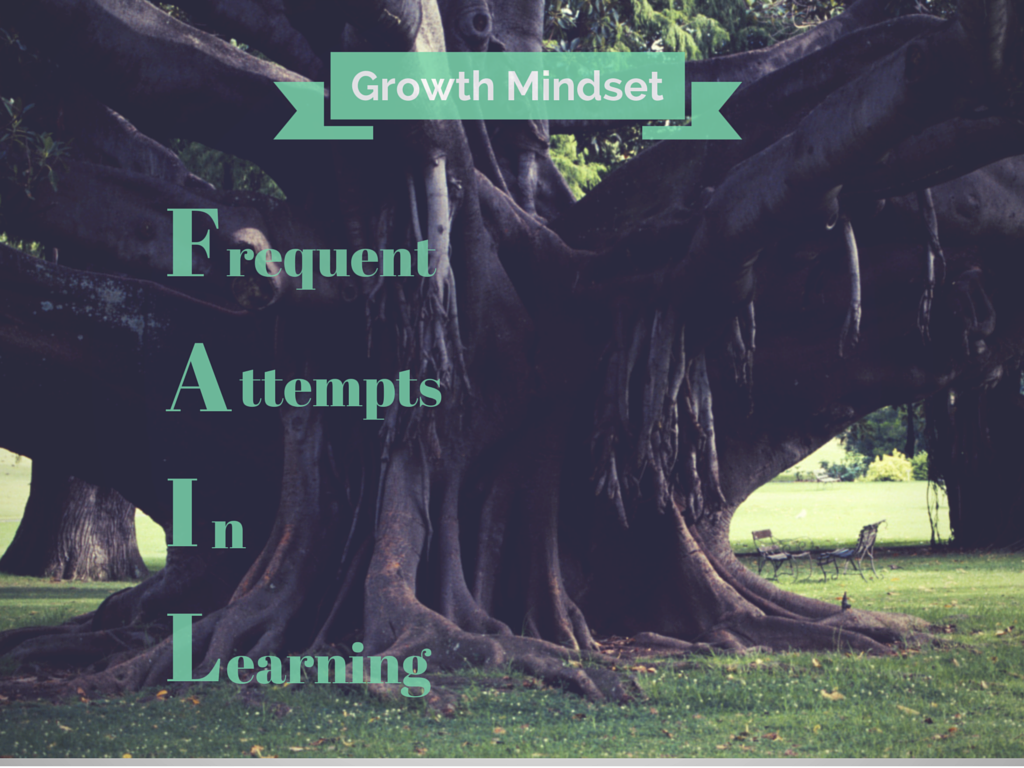
Some of you might have seen something along the lines of this picture before floating around the internet. Failure is part of the learning process. If every student within your class realizes that they will fail at some point and that when they do their efforts to succeed will be celebrated, then the barrier of failure begins to break down. It will also encourage the students in your class who have a harder time performing a task or who process things slower to continue trying.
Student Comparison
Considering the nature of physical education it can be difficult to avoid one student comparing themselves to another. Telling students on a daily basis that everyone is learning at their own pace and that the process of learning a particular skill is just as important as mastering that skill tends to help prevent this. Furthermore, never forcing students to demonstrate a skill in front of peers can help avoid this comparison.
Teaching Strategies for Working with Students with Learning Disabilities
There is no one teaching strategy that will work with every student with a learning disability because of the variety of different learning disabilities. It requires time getting to know and understand each individual student and their disability before finding the best way to help them learn. Here are a few strategies I suggest you try when working with a student who has a disability.
1) When explaining a learning objective always verbalize it, demonstrate it and give time for students to practice doing it. This may sound easy enough but often I catch myself at the end of class trying to fit one more thing in as students are leaving by verbalizing it only. However, this doesn’t resonate with all of my students. Some must be able to see what I’m talking about in order to grasp the concept and others will only learn and remember by doing it. When concepts are verbalized, demonstrated and performed it is more likely that the needs of students who process thing slower will be met.
2) Make sure to check in with students with learning disabilities often. What I mean by this is have informal conversations throughout the course of your lesson to check for their understanding. By doing this your more in-tune with your students’ comfort level during the learning task. Furthermore, it gives students the opportunity to advocate for themselves if they do not understand something or need a modification to the task.
3) When testing or assessing learning outcomes, realize that students with learning disabilities may understand the learning outcomes but be unable to show you their comprehension in the way you are asking them. For example, when a student with a learning disability takes a written test, he or she may not score as well as if you were to assess them using a different format. Alternative ways to assess students could be, 1) Administer the assessment verbally to the student. This could be done by reading an assessment out loud to a student and having them verbally give you the answer to the assessment. Adding in visuals could also be helpful. 2) Have the student act out the assessment. An example of this would be having a student show you the correct overhand throw form compared to picking out a picture or a written description on a multiple choice test.
Help Students Embrace Their Learning Disability
It is important to realize that learning disabilities are never overcome in the sense that they don’t go away, but they can be embraced as a strength. This can take a while for those who have a learning disability to understand. This is the process I went through as I figured out my learning disability and it could be similar for others as well: 1) Discover you have a learning disability, 2) Learn to advocate for yourself because of your learning style and 3) Fully embrace your learning disability and look at it as a strength.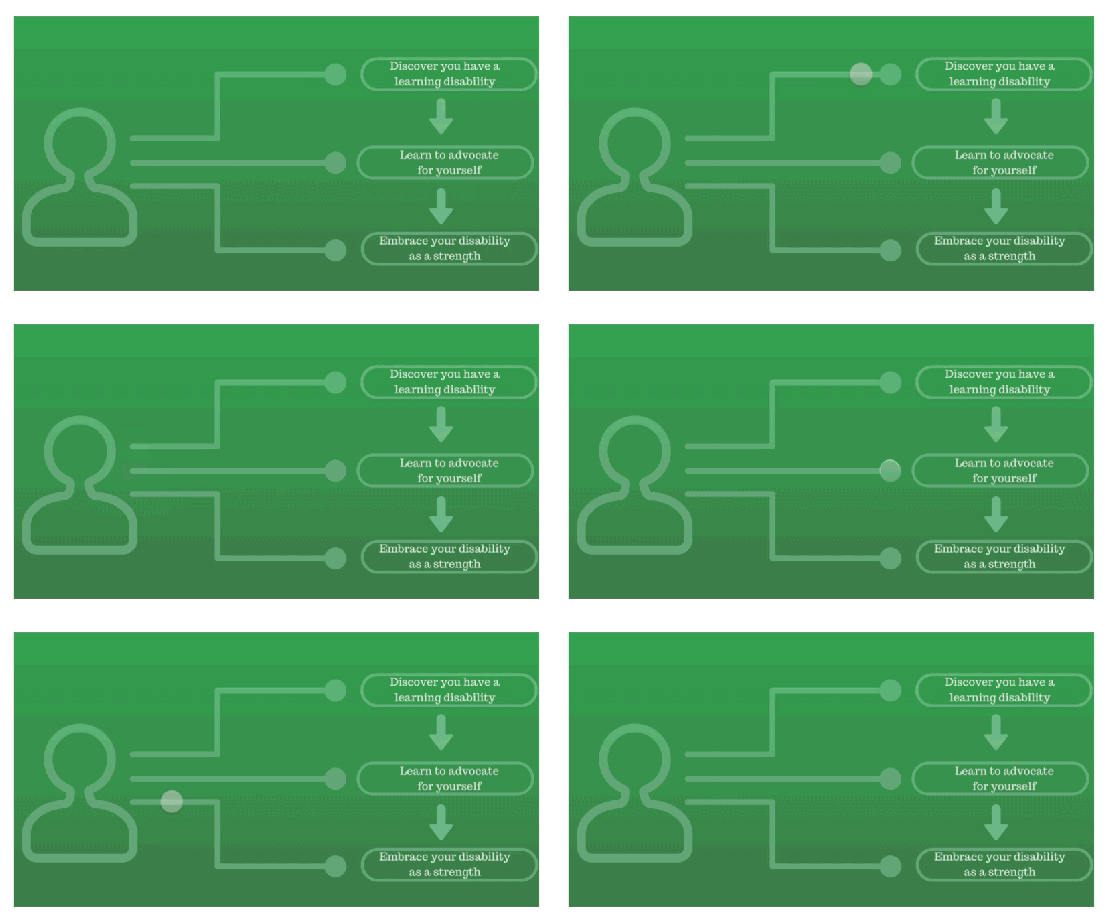
The biggest role I see physical educators playing is helping teach students to advocate for themselves. This is a learned skilled. Simply being approachable and reminding students to communicate with you about what they need is a great starting point.
Never Put a Ceiling on Your Students
Lastly, and perhaps most importantly, I want remind physical educators that putting a ceiling on someone’s ability to achieve, whether it is in our class or within their life, is a huge disservice. I can think back to a few instances within my life where I was told what I would or wouldn’t be able to achieve. To this day these experiences are still distinct memories of frustration to me. When it comes to measuring someone’s ability to be successful in our classes we need to have an open mind and not make assumptions or judgments.
It was a 20 year journey to work through this process of embracing my learning disability and it took a lot of encouragement from my family and teachers along the way. I can remember vividly all of those who helped contribute to me being successful in school and I am so grateful. I desire for students to exit my classroom with a similar feeling. I leave you with my favorite TED Talk from Angela Lee Duckworth discussing her research on the growth mindset.


 PHYSEDAGOGY